Restoring movement should not come at the cost of accessibility, comfort, or intuitive control. EMBRACE is an open-source, affordable prosthetic arm that uses non-invasive EMG sensors and real-time machine learning to give amputees natural, multi-gesture hand control without the barriers of cost, complexity, or closed systems. Designed by a passionate team of Biomedical and Computer Science engineers at UC Irvine, EMBRACE exists to make advanced prosthetic technology available to everyone who needs it.
Clinical Background
Select any card to learn more
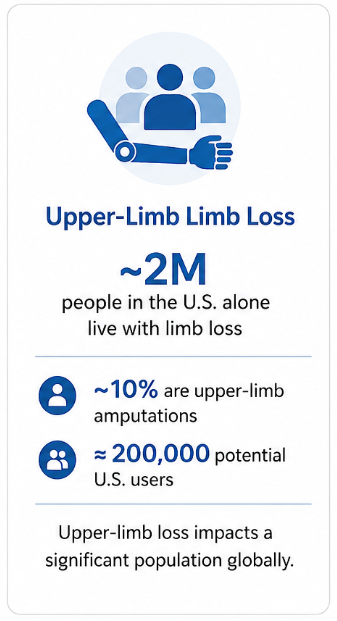
Upper-Limb Loss
Upper-limb loss affects millions of individuals across the United States and globally. Whether caused by trauma, disease, or congenital conditions, the loss of an arm or hand dramatically impacts a person's ability to perform daily tasks. With approximately 200,000 potential users in the U.S. alone, the demand for effective, accessible prosthetic solutions is significant and growing.
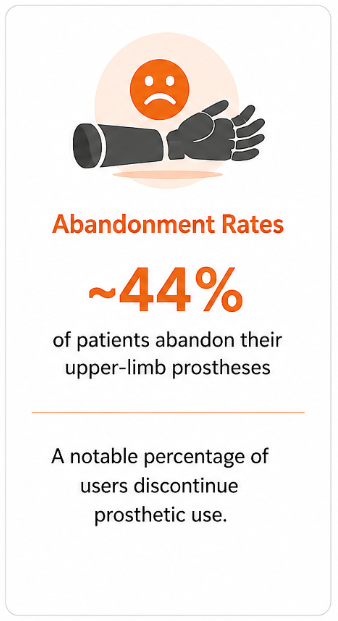
Abandonment Rates
Nearly half of all upper-limb prosthetic users eventually abandon their devices. The leading reasons include discomfort, poor functionality, lack of intuitive control, and high cost of maintenance. This alarming rate highlights a critical gap in current prosthetic design — devices that fail to meet the real-world needs of patients.
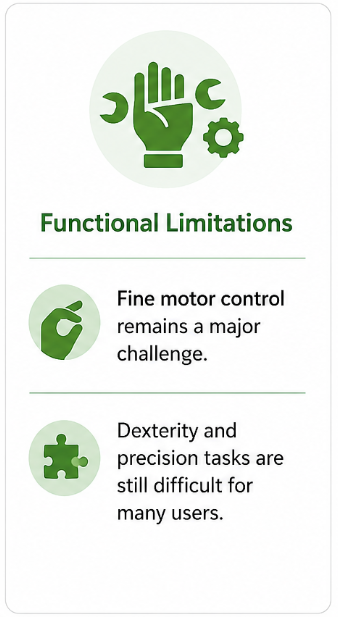
Functional Limitations
Current prosthetic technology still struggles to replicate the natural dexterity of the human hand. Fine motor tasks such as picking up small objects, typing, or buttoning a shirt remain difficult or impossible for many prosthetic users. Without intuitive, real-time control systems, prosthetics often feel unnatural and frustrating to use — directly contributing to high abandonment rates.
Needs Statement
Upper-limb amputees need a low-cost, intuitive, and non-invasive prosthetic arm that can accurately interpret muscle signals in real time to deliver natural, multi-gesture hand control. Current solutions are often prohibitively expensive, uncomfortable, or incapable of replicating the dexterity required for everyday tasks. EMBRACE addresses this gap by leveraging surface EMG sensors and machine learning to classify user intent and drive a 6-degree-of-freedom prosthetic arm — restoring functional independence through a system that is accessible, comfortable, and responsive to the needs of real patients.
Our Goals
High abandonment rates show that prosthetic technology still does not fully meet user needs. EMBRACE combines biomedical engineering, mechanical design, signal processing, and human-centered design to change that.
💰
Affordable
Design a sub-$1,200 open-source prosthetic accessible to a wider range of patients.
🧠
Intuitive Control
Use EMG signals and real-time machine learning to enable natural, multi-gesture hand control.
🖨️
Custom Fit
Leverage 3D-printed components to create a comfortable, patient-specific prosthetic fit.
🙌
Real-World Usability
Validate system performance to help users regain functional control and confidence in everyday tasks.